
Last updated September 10, 2026
Full 25-point door and opener safety check with every visit - springs, cables, rollers, tracks, and your LiftMaster or Chamberlain opener included
You get a price before we start. It does not change when the truck arrives.
 Before
 After
After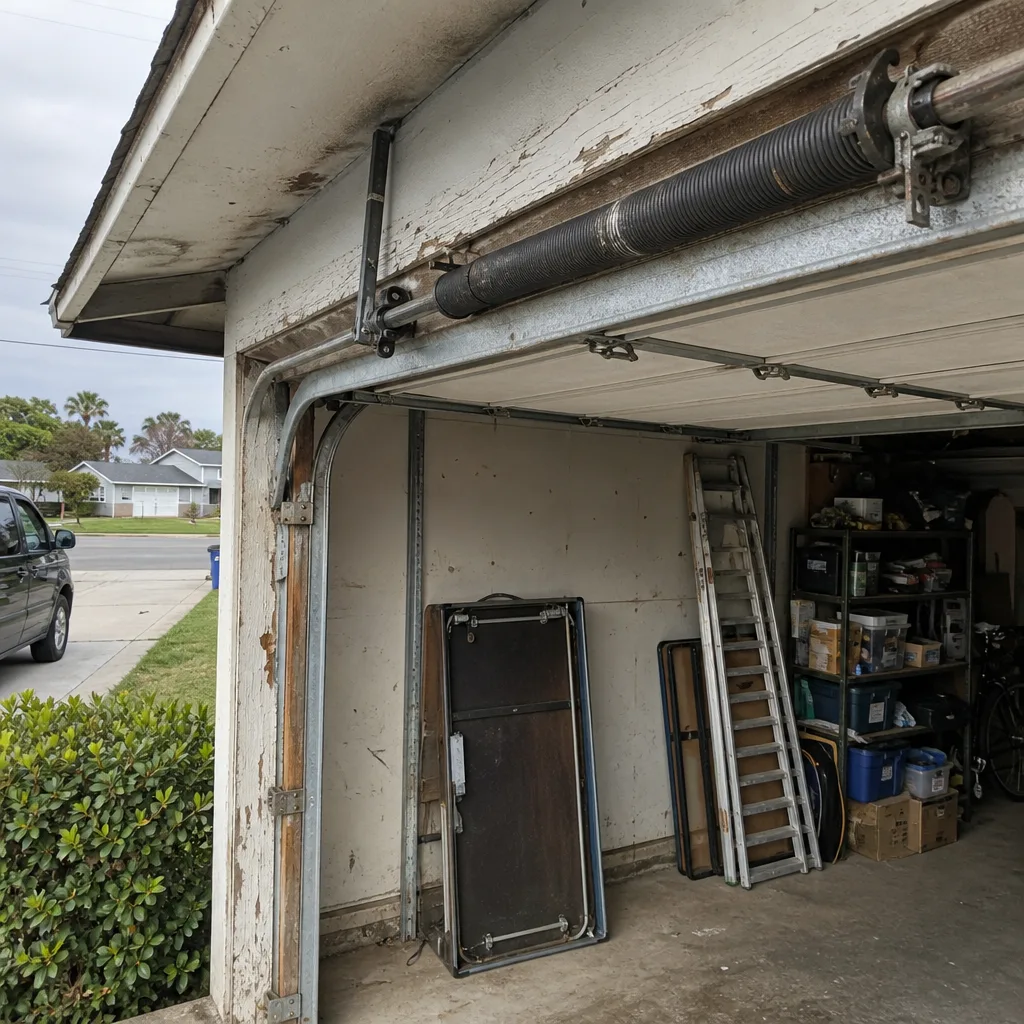 Before
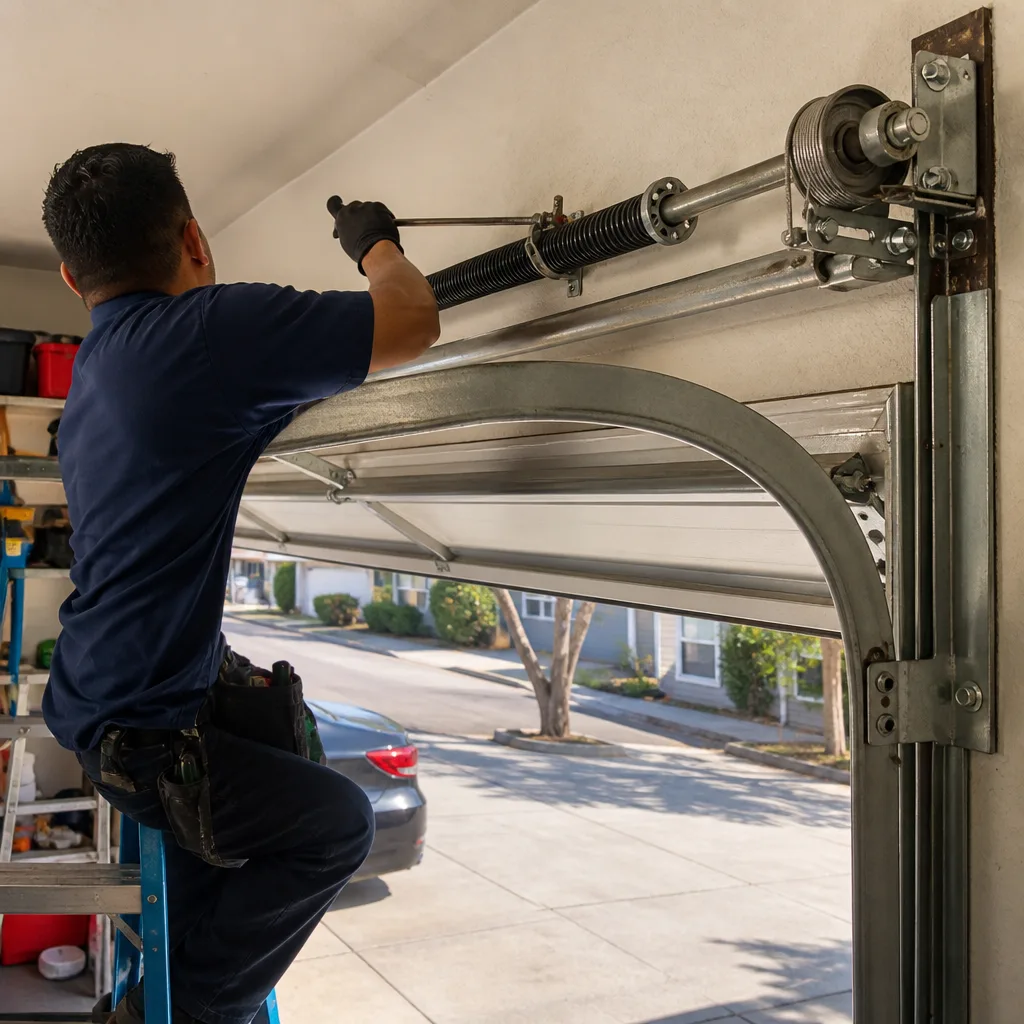 After
After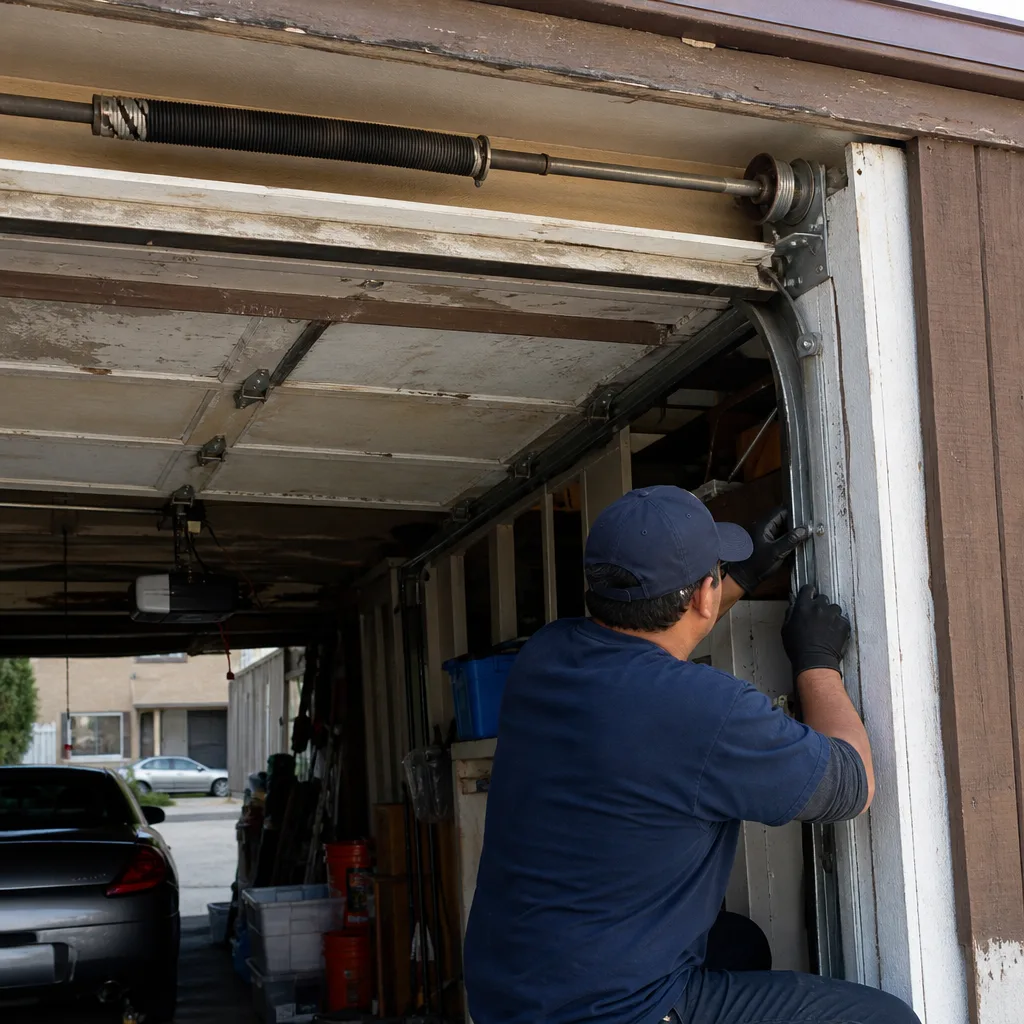 Before
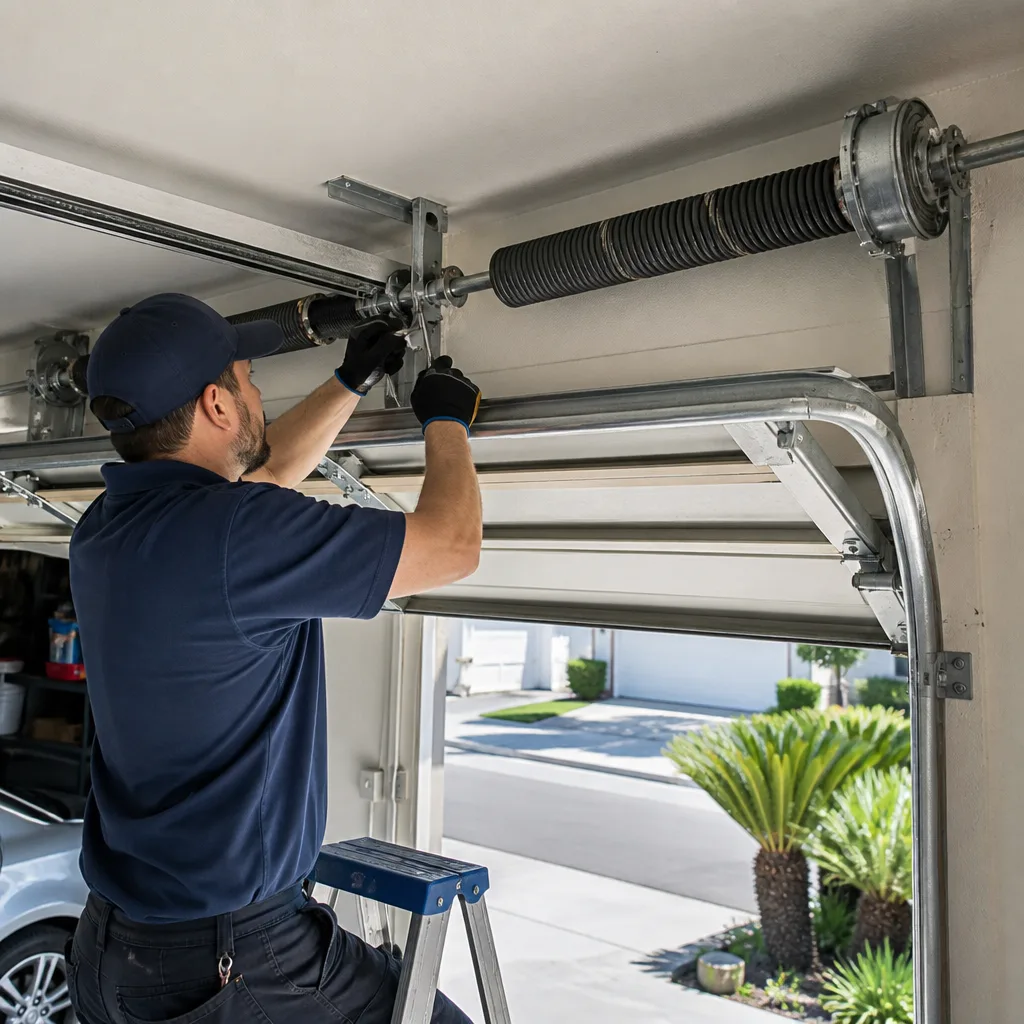 After
AfterGarage Door Warning Signs: A Long Beach Homeowner’s Reference Guide
Here’s a number that catches most Long Beach homeowners off guard: the average garage door opens and closes about 1,500 times a year, and nearly every emergency repair call we run has one thing in common. The homeowner saw or heard something unusual for weeks, sometimes months, before the door finally gave out. They just didn’t know it mattered. This guide will teach you what actually matters, so you can spot a failing spring in March instead of meeting a broken one at 6 a.m. on a workday. For The Complete Guide to Garage Door in Long Beach, see our expanded resource.
Quick Answer
Garage door warning signs fall into three categories you can check yourself: sounds (grinding, popping, squealing, or a sharp bang), movement (slow on one side, shaking, reversing for no reason), and visible wear (frayed cables, cracked springs, rust bleeding through the door face). Most failures announce themselves 30 to 90 days early, and catching them then means a $75 part instead of a $400 emergency call. In Long Beach, salt air and coastal moisture speed up hardware wear, so a door that looks fine can still be hiding corrosion you can’t see from the street.
Table of Contents
- The Sounds Your Door Makes: What Each One Means
- Movement Warning Signs: Three Problems, Three Urgency Levels
- The Visual Checklist: What Wear Actually Looks Like
- Long Beach-Specific Warning Signs: Salt, Moisture, and Seasonal Binding
- Urgency Triage: Stop Now, Book This Week, or Watch It
- Six Garage Door Myths That Cost Long Beach Homeowners Money
- Common Mistakes to Avoid
- When to Call a Professional
- Frequently Asked Questions
- The Bottom Line
The Sounds Your Door Makes: What Each One Means
A garage door is a 200-pound slab riding on two springs, a handful of rollers, and a track system that’s bolted to your ceiling. Every sound it makes is information. The problem is that most homeowners have been told every noise is “just the door settling” or “normal wear.” It isn’t. Here’s what four specific noises mean when you hear them in a Long Beach garage.
The Grinding Noise
A grinding noise, especially one that comes and goes as the door moves, almost always points to a worn roller or a hinge that’s losing its bearing. The roller is a small wheel with a metal stem, and inside that wheel is a bearing. When the bearing dries out or wears down, the roller stops spinning smoothly and starts dragging metal on metal. You’ll hear it most clearly when the door is about halfway up, because that’s when the rollers carry the most weight through the curved track.
Left alone, a grinding roller doesn’t just get louder. It chews up the track, which turns a $30 roller replacement into a $200 track job. In our experience, rollers last 7 to 10 years in a typical Long Beach garage, but doors within a mile of the water often need them at 5 years because salt air works into the bearing grease. If the grinding is paired with the door feeling heavier than it used to, that’s a different problem entirely, and it’s covered in the movement section below.
The Popping Noise
A popping or snapping sound during operation is cable tension doing something it shouldn’t. Your door has two cables, one on each side, that run from the bottom of the door up to the spring system. When they’re working right, they stay taut and silent. When you hear a pop, it usually means a cable is catching on a rough spot on the drum or a strand has already begun to fray and is slipping.
This is not a “keep an eye on it” sound. A frayed cable under tension is holding hundreds of pounds of stored energy, and when it lets go, the door can drop suddenly or jerk violently to one side. If you hear a pop more than once, stop using the door and call someone. In Long Beach, where many homes have attached garages with bedrooms above them, a dropping door isn’t just a dent in your car, it’s a structural shock to the whole assembly.
The Squealing Noise
Squealing is the one sound on this list that’s usually benign in the short term. It means lubrication has worn off somewhere, typically on the rollers, hinges, or the spring itself. A dry spring is the most common culprit in coastal Long Beach, because the marine layer deposits moisture that evaporates and leaves behind a film that breaks down lubricant faster than inland air does. For a full maintenance schedule, see our Seasonal Garage Door Care for Long Beach: Year-Round Homeowner’s Guide.
The fix is simple: a spray lubricant designed for garage doors, applied to the spring, hinges, and rollers twice a year. What you shouldn’t do is ignore it forever. A dry spring wears faster than a lubricated one, and a dry hinge will eventually seize and snap. Think of it like an oil change, cheap maintenance now, expensive repairs later. But we want to be straight with you: if the squeal is accompanied by visible rust flakes or the spring looks dull and scaly, lubrication isn’t enough. That spring is near the end of its life.
The Bang on Closing
This is the one sound that sends us to the most emergency calls. A sharp bang when the door closes, especially a bang followed by the door slamming down or refusing to open again, is almost always a torsion spring letting go. Torsion springs sit horizontal on a bar above the closed door, and they’re rated for a specific number of cycles. A standard spring from a hardware store is rated for 10,000 cycles, which sounds like a lot until you do the math: 1,500 cycles a year means about 6 to 7 years of service. When the spring breaks, the sound is loud enough that neighbors have called us about it before the homeowner did.
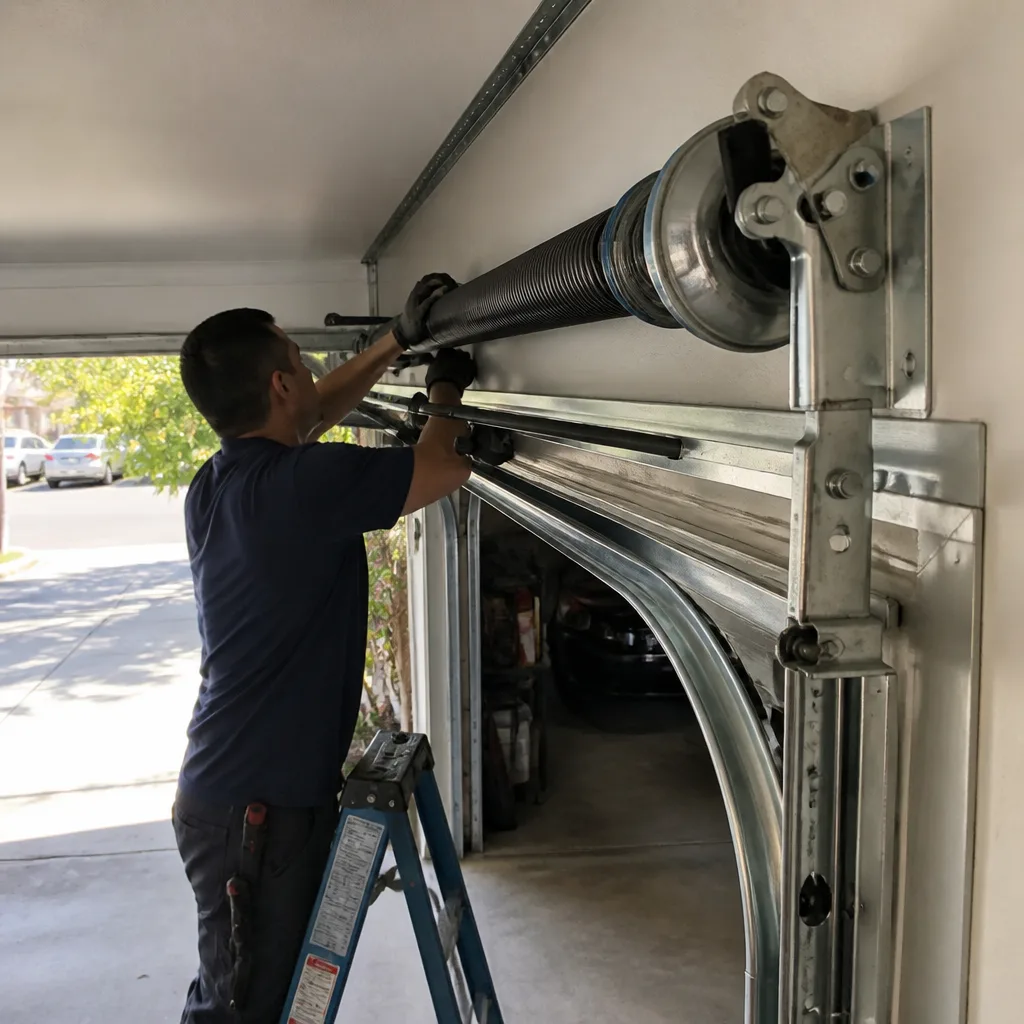
Here’s the thing: a broken torsion spring is the single most dangerous component in your garage. It is under enough tension to lift a 200-pound door, and when it fails, that energy releases in a fraction of a second. Do not attempt to replace it yourself. Do not try to open the door manually. Call a professional. We will come out, and we will quote the job on that call and hold that price when we get there. That’s how garage door repair in Long Beach should work.
Movement Warning Signs: Three Problems, Three Urgency Levels
How your door moves tells you more than how it sounds. A door that travels smoothly and evenly is a door that’s balanced, aligned, and properly tensioned. A door that doesn’t is sending you a message. Here are three movement problems, what they mean structurally, and how urgently you need to act.
Slow on One Side: The Structure Is Failing
If the door rises faster on one side than the other, you have a structural or tension imbalance. In a healthy door, both springs carry equal load, both cables stay taut, and the door tracks evenly. When one side lags, it means one of three things: one spring is weakening while the other holds, one cable has stretched or begun to fray, or the track on the slow side has been knocked out of alignment.
This is a this-week problem, not a next-month problem. Every cycle you run with an imbalanced door adds stress to the stronger side, which means you’re actively wearing out the remaining good spring. In neighborhoods like Belmont Heights or Naples, where many homes have original door hardware from the 1980s and 1990s, we see this pattern constantly: one spring fails, the homeowner doesn’t notice the imbalance, and the second spring fails within six months. Catching it early means replacing one spring instead of waiting for two.
Shaking During Travel: The Track Is Under Stress
A door that shudders or visibly shakes as it moves is almost never a spring problem. It’s a track or roller problem. The energy of the door moving is being interrupted somewhere, either by a bent track section, a loose track bracket, a wobbling roller, or debris caught in the track. Shaking is the door’s way of telling you that something is binding and will eventually bind completely.
The urgency here depends on severity. A mild vibration on a 15-year-old door with original rollers is normal wear and can wait for a maintenance visit. A visible shake that makes the opener rail tremble is a stop-using-it-this-week problem. The danger with shaking is that it works bolts loose over time. A track bracket that vibrates for six months will eventually pop its lag screws out of the ceiling joist, and then the track itself can separate while the door is overhead. That’s a repair that involves new hardware, realigned track, and possibly door panel damage, all of which is preventable.
Stops and Reverses for No Reason: The Safeties Are Speaking
If your door starts to close, stops, and reverses back up without hitting anything, your safety sensors are triggering. This is not a defect in the opener. It’s the opener doing exactly what it was designed to do. The question is why.
Modern openers made by LiftMaster, Genie, and Chamberlain all use infrared sensors mounted about six inches off the floor on each side of the door opening. If anything interrupts the beam, the door won’t close. In Long Beach specifically, we see two culprits more than anything else: spider webs draped across the sensor lens, and salt-crusted lenses from coastal air. Both are easy fixes: wipe the lens with a dry cloth and check the alignment. If the sensors are clean and aligned but the door still reverses, the problem may be the opener’s force setting, which drifts over time, or a failing logic board, which is more common on openers older than 12 years.
Here’s an experience worth sharing: we once got called to a home in Bixby Knolls where the door had been reversing for two weeks. The homeowner thought the opener was dying and was pricing replacements. It was a spider web. If you have an older opener and you’re not sure whether to repair or replace it, we walk through that decision on our garage door opener in Long Beach page without the sales pressure.
The Visual Checklist: What Wear Actually Looks Like
You don’t need to be mechanically inclined to read your garage door. You just need to know what to look at and what a healthy component looks like versus one that’s failing. Here’s the five-point check we walk homeowners through on every tune-up visit, and you can do it in about three minutes from your driveway.
- The cables. Look at each cable where it winds around the drum above the top corners of the door. A healthy cable is smooth, uniform, and either silver or coated. When a cable has about three months left, you’ll see individual strands beginning to separate, usually near the drum or where the cable attaches to the bottom bracket. When strands separate, the cable cross-section is shrinking, and the remaining strands are carrying more load. If you see rust staining on the cable itself or any strand that’s broken and sticking out, that cable is in its final days. Stop using the door and get it replaced before it snaps under tension.
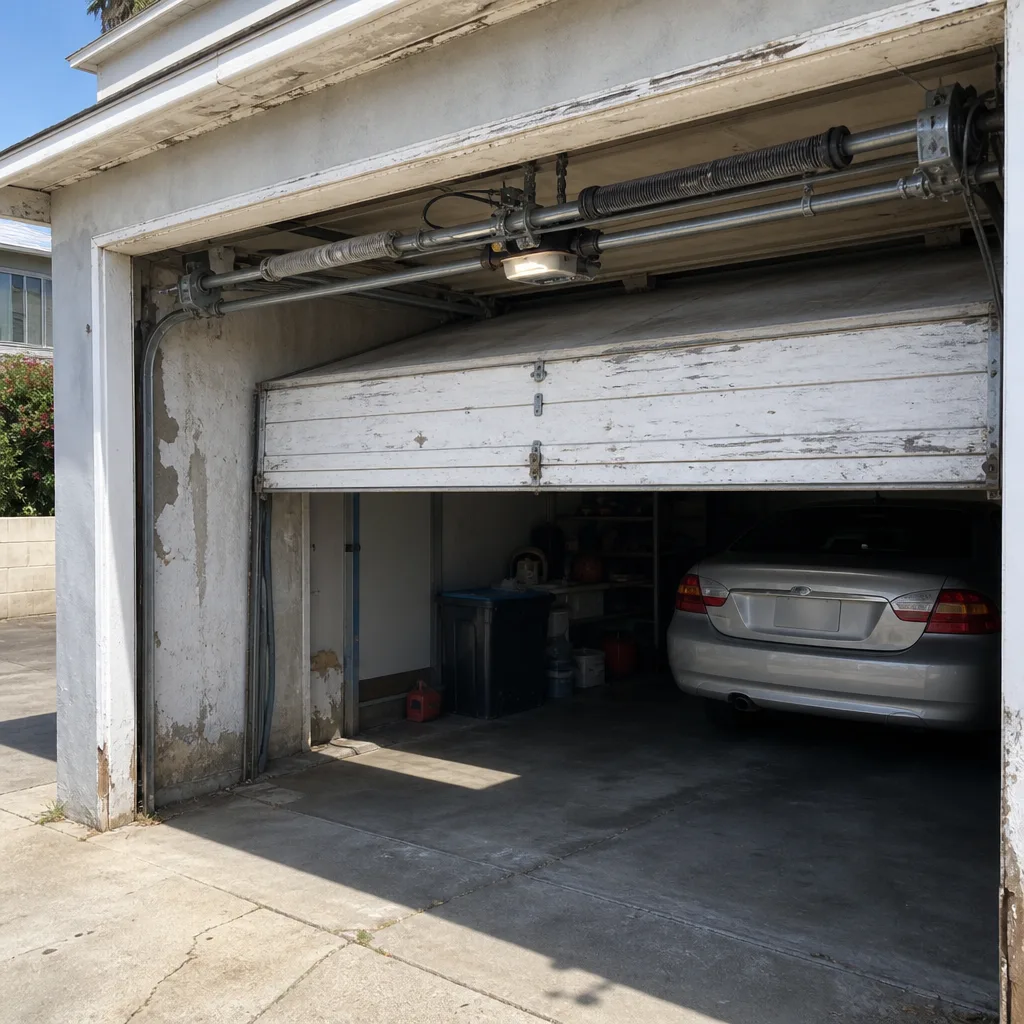
- The torsion spring. Look above the closed door. A healthy torsion spring is a continuous coil with no gaps and no visible cracks. A failing spring shows one of three signs: a visible gap in the coil where it has broken, rust bleeding through the coil’s surface, or a worn, dull appearance where the galvanized coating has failed. If you see a gap, the spring is already broken. If you see deep rust or flaking, the spring has lost structural integrity and is running on borrowed time. In coastal Long Beach, where salt air accelerates rust, springs that look like this are 6 to 12 months from failure at most.
- The rollers. Check the wheels that ride in the track. A healthy roller is round, sits flush against the track, and has no play when you push on the stem. A roller with a failing bearing will wobble when you touch it, and the wheel may have visible flat spots or metal showing through the outer surface. Nylon rollers with ball bearings last longest in Long Beach’s salt air. Steel rollers without bearings fail fast, and when they do, they chew the track.
- The track itself. Run your eyes along each vertical track and the horizontal curve. Look for gaps between the track and the wall brackets, any bolt that’s backed out, and any section that’s bent or squeezed. A track that’s pulling away from the wall is under sideways load, usually from an imbalanced door. Left unchecked, the track can separate while the door is in motion.
- The door face and panels. This one surprises people. The panels on a sectional door are connected by hinges, and the panels themselves are typically steel with a foam or polystyrene core. When the panel’s bottom seal fails, water gets inside the panel, and in Long Beach that water is salt-laden. The result is rust streaking down the face of the door from the inside out, and by the time you see it, the panel’s structural steel is already compromised. We cover this more in the next section.
Long Beach-Specific Warning Signs: Salt, Moisture, and Seasonal Binding
Every garage door in Long Beach lives with two environmental realities that a door in Riverside or Ontario doesn’t: salt air from the Pacific and moisture cycles from the marine layer. Both create warning signs that look different from what generic garage door guides describe.
Rust Streaking on the Door Face
When you see rust-colored streaks running down from the hinge lines or the bottom edge of a garage door panel, that’s not surface rust from the outside. That’s the panel’s internal steel rusting after water got in. It works like this: the bottom seal wears out or a hinge gasket fails, water wicks up into the panel’s foam core, and because that water in Long Beach carries salt from the ocean breeze, it corrodes the steel skin from the inside. The streaking is the runoff.
By the time rust streaking is visible on the outside, the panel’s structure is already weakened. The door may still operate, but that panel is degrading every time the marine layer rolls in. In neighborhoods within a mile of the water, like Alamitos Beach or the Peninsula, we see panels fail this way in 8 to 12 years. The fix is panel replacement, which is significantly cheaper than a full door replacement if caught before the corrosion spreads to the hinge points. If you check your door now and find the bottom seal is cracked or missing, replacing that $20 part will buy you years.
The December Binding Problem
Long Beach homeowners sometimes report a door that worked fine all summer and then starts binding, sticking, or running slow in December. This is usually not a hardware failure. It’s the wood frame around the door absorbing winter moisture and swelling against the door’s edge. Long Beach’s December humidity, combined with cooler temperatures, causes the wood jamb to expand just enough to make contact with the door panel.
The fix is sometimes as simple as clearing the contact point with a hand plane, but it should be done deliberately. A door that binds on the frame is putting sideways load on the track and the rollers, and if you run it that way for months, you’ll wear out rollers and bend brackets. If your door is binding in winter and you’re not sure whether it’s the frame or the hardware, that’s exactly the kind of thing a Otto’s Garage Door home tune-up exists to diagnose. We’d rather spend twenty minutes checking your frame than sell you a spring you don’t need.
What Salt Air Does to Springs and Hardware
Garage door springs are made of oil-tempered steel wire with a protective coating. That coating is designed for typical inland conditions, not for constant salt exposure. In Long Beach, especially in homes within a few blocks of the ocean, spring coatings fail faster, and once the coating fails, the steel begins to rust. A rusted spring doesn’t just look bad. Rust creates surface pitting, and surface pitting creates stress concentration points where the spring will eventually crack. The life expectancy difference is real: a spring that might last 10 years in Los Alamitos might last 7 in Naples. If your springs show rust scaling or flaking, they’re telling you they’re in their final year of service, regardless of what the cycle count says.
Urgency Triage: Stop Now, Book This Week, or Watch It
Every warning sign in this guide falls into one of three urgency buckets. Here’s how to sort what you’re seeing or hearing.
Stop Using the Door Right Now
- Broken torsion spring with a visible gap in the coil
- Frayed cable with separated strands or a broken strand sticking out
- Repeated popping or snapping sounds from the cable drum area
- Door that shakes violently side to side during travel
- Track that has visibly separated from the wall or ceiling brackets
These are not maintenance items. They’re safety failures waiting to happen. A door in any of these conditions can drop, jerk sideways, or tear its track out of the ceiling. Leave the door closed, leave the car outside if you can, and call a professional. We answer 24/7, and we’ll quote the repair on the phone.
Book a Service Call This Week
- Door that’s slow on one side or uneven at the bottom when open
- Grinding noise that’s getting louder or more constant
- Rust streaking on the door face panels
- Persistent squealing that doesn’t resolve after lubrication
- Opener that’s reversing even with clean, aligned sensors
These problems are actively wearing out surrounding components. The longer you wait, the more you’ll spend. A slow-on-one-side door is killing the good spring. A grinding roller is chewing the track. None of these will fix themselves, and each one gets more expensive every week you postpone.
Add to Next Month’s Maintenance Visit
- Mild vibration that’s been present for years and hasn’t worsened
- Slight squeal that goes away after lubrication
- Bottom seal that’s beginning to crack but hasn’t separated yet
- Weatherstripping gaps that are letting dust in but not water
- Minor surface rust on brackets that are still structurally sound
These are the “keep an eye on it, but don’t lose sleep” items. That said, if you haven’t had a professional look at your door in more than two years, the maintenance visit is worth scheduling regardless. We check cable wear, spring condition, balance, and opener force settings, and we’ll tell you if anything in the “watch it” bucket has quietly moved into the “fix it now” bucket.
Six Garage Door Myths That Cost Long Beach Homeowners Money
After 29 years of working on doors in this county, Otto has heard every piece of garage door folk wisdom there is. A few are true. Most are expensive. Here are the ones that cost homeowners the most money.
Myth 1: “If the door makes noise, just lubricate it.”
Lubrication fixes a dry hinge or a dry spring. It does not fix a worn bearing, a frayed cable, or a spring that’s already cracked. If you lubricate and the noise is still there a week later, the lubricant wasn’t the problem. Continuing to run the door while you wait for the noise to go away is how $40 roller replacements become $400 track replacements.
Myth 2: “Garage door springs are rated for a million cycles.”
No. Standard springs are rated for 10,000 cycles. High-cycle springs are rated for 20,000 to 50,000 cycles, and they cost more up front for a reason. A 10,000-cycle spring in a Long Beach household that uses the door four times a day will last about 7 years. That’s not a defect. That’s reality. If your springs are older than that and you use the door daily, you’re driving on borrowed time.
Myth 3: “If one spring breaks, I only need to replace that one.”
You can do that, and some people do, and it saves money for about six months. Then the other spring breaks, because both springs were installed at the same time, cycled the same number of times, and wore at the same rate. Replacing one spring is buying half a repair. Most professionals won’t do it, and the ones who will are doing you a disservice. When we replace springs, we replace both, and we install springs matched to your door’s weight and balance, not whatever’s cheapest.
Myth 4: “The opener has a lot of power, so it can push through a binding door.”
The opener is not designed to push through resistance. It’s designed to move a balanced door. If the door is binding, the opener’s motor is working against the door every cycle, and that’s how opener gears strip and logic boards burn out. A door that requires a stronger opener was already broken. We’ve seen openers die in three years because they were fighting a door that a $150 service call could have fixed.
Myth 5: “A new door will solve all the problems with the old door.”
A new door will not fix bad track, failing springs, or a warped frame. Those are separate components. If you replace the door but keep the old track and old springs, you’re putting a new panel on old infrastructure, and the old infrastructure is what was making the old door run badly. A legitimate garage door installation in Long Beach includes assessing the track, springs, and opener as part of the quote. If someone offers to slap a new door on your existing track without inspecting it first, get a second opinion.
Myth 6: “The safety sensors are a government overreach and I should just bypass them.”
Nobody says it in those words, but we see bypassed sensors all the time, usually because the door was reversing and someone “fixed” it by taping the sensors together or splicing the wire. Do not bypass the safety sensors. They exist because garage doors have killed people, children especially. A sensor that’s tripping is telling you something, and the answer is to find out what, not to disable the warning. On this one we won’t bend: we will not disable a safety sensor, and we will reconnect any that have been intentionally bypassed.
Common Mistakes to Avoid
- Ignoring a noise because the door still works. The door will keep working right up until it doesn’t. Every failure is preceded by a working door. If the sound changed, something changed, and that change has a cause. In our experience, the homeowners who avoid the worst repairs are the ones who call when the noise first appears, not when the door stops.
- Lubricating a failing part thinking it’s “maintenance.” Lubricant reduces friction. It does not restore structural steel, rewind cable strands, or fix a bearing. If the part is failing, lubrication just makes it fail more quietly. Quiet failure is not an improvement.
- Waiting for a “convenient time” to replace a visibly frayed cable. A frayed cable doesn’t care about your calendar. It will snap on a Tuesday morning, on the way to an appointment, in the rain, whatever. We see this pattern constantly in Long Beach, where homeowners with ocean-facing garages notice the corrosion in March but wait until summer. By July, the cable is gone.
- Assuming the opener is the problem when the door is the problem. If the door is hard to lift manually, the opener wasn’t designed to compensate. The opener is a convenience, not a structural support. Replacing a working opener because the door is binding is like replacing the engine when the tire is flat. We’ll tell you if your opener actually needs replacement, and we don’t sell one when the door is the real problem.
- DIY spring replacement. We say this as people who have retrieved broken springs from garage walls, car hoods, and once a kitchen ceiling. Torsion springs store enough energy to lift your door, and that energy has to go somewhere when the spring is unwound. If you don’t have the winding bars, the training, and a healthy respect for stored energy, you don’t have the job. This is the one repair where the phrase “it looked easy on YouTube” has led to hospital visits. It is not worth the savings.
- Ignoring rust streaking because “it’s just cosmetic.” Rust streaking from the inside of a panel is not cosmetic. It’s a structural failure in progress. The panel’s steel skin is corroding from the inside, and every wet winter in Long Beach accelerates it. The longer you wait, the more panels you’ll replace, and panel matching on an older door is not always possible, which pushes you toward a full door replacement.
- Not checking the door balance after a spring replacement. A properly balanced door should stay put at waist height when you release it, neither rising nor falling. If a new spring isn’t matched to the door’s weight, the door will be unbalanced, and an unbalanced door eats rollers, track, and opener parts. This is why we test the balance on every spring job before we leave and write it on the invoice.
When to Call a Professional
Here’s a straight answer. Call a professional if your door shows any of the stop-now signs we listed in the triage section, if it makes a noise you can’t identify, if it’s moving unevenly, if you can see cable or spring wear, or if it’s simply been more than two years since anyone who knows doors has looked at it. A tune-up costs less than the repair you’re preventing. Otto’s Garage Door offers free estimates in Long Beach, and we mean free: no trip charge inside the county, no pressure to approve work you don’t need. Call (562) 373-6685 and a live person will answer, day or night. We’ll quote the job on that call and hold that price at the door.
Frequently Asked Questions
A spring that’s about to break shows visible rust scaling, surface pitting, or a worn, dull appearance where the protective coating has failed, and it may make a creaking sound as it winds. In Long Beach’s salt air, coating failure happens faster than inland, so check springs in ocean-adjacent neighborhoods at least twice a year. If your door is also feeling heavier than it used to or uneven when closing, those are additional signs the spring is losing tension. Call (562) 373-6685 and we’ll tell you what’s left on it.
A grinding sound is a rough, metallic scraping that often pulses as the door moves, and it’s most noticeable when the door is halfway up. It points to a worn roller bearing or a failing hinge, and it’s moderately urgent: the roller is chewing up the track with every cycle, and the repair cost grows over time. A grinding door can run for weeks but shouldn’t, because a $30 roller is cheaper than a $200 track section. If you’re hearing it in Long Beach, where salt air shortens bearing life, have it checked sooner rather than later.
A garage door that shakes during travel has a track or roller problem, not a spring problem. The energy of the moving door is being interrupted by a bent track section, a loose bracket, a wobbling roller, or debris in the track. Mild vibration on an older door is normal; a visible shake that makes the opener rail tremble is a stop-using-it-this-week issue. Shaking works bolts loose, and a track that separates from the ceiling while the door is overhead is dangerous.
A garage door that reverses with no visible obstruction is usually tripping its safety sensors, and in Long Beach the two most common causes are spider webs across the sensor lens and salt crust from coastal air. Wipe both lenses with a dry cloth and make sure the sensors are aligned, then test the door again. If it still reverses with clean, aligned sensors, the opener’s force setting may need adjustment or the logic board may be failing, especially on openers older than 12 years.
Rust streaking down the face of a garage door panel is serious and usually indicates that water with salt content has gotten inside the panel and is corroding the steel from within. The rust you see on the outside is runoff from internal corrosion, and the panel’s structural integrity is already compromised. In Long Beach, where marine-layer moisture is constant, internal panel rust gets worse every winter. Replacing one panel early is far cheaper than replacing a whole door later, and panel matching gets harder as the door ages.
Standard springs rated for 10,000 cycles last about 7 years in a typical Long Beach household that uses the door four times a day. Near the coast, salt air shortens that lifespan by a year or two because the spring coating fails faster and the steel begins to rust. High-cycle springs rated for 20,000 to 50,000 cycles cost more up front but are worth it if you’re planning to stay in the house, and we’ll match the spring to your door weight and your actual usage, not the cheapest option on the shelf.
The Bottom Line
Your garage door tells you when it’s failing, but only if you know how to listen and look. Grinding means rollers. Popping means cables. Banging means springs. Slow on one side means imbalance. Shaking means track. Rust streaking means internal panel corrosion, and in Long Beach, salt air and marine moisture make all of it happen faster. The door you use four times a day is the hardest-working moving part in your house, and it deserves the same attention you give your car’s oil change. When the signs show up, call (562) 373-6685. Otto will answer, quote the job on the phone, and hold the price when he shows up. That’s the deal, the same one we’ve been running in this county since 2004.
Written by Otto Reinhardt, Owner at Otto’s Garage Door, serving Long Beach since 2004.